
9/30/2024
누가복음을 거꾸로 읽으며 '제국의 경계'와 마주하기
by 낸시 크로우
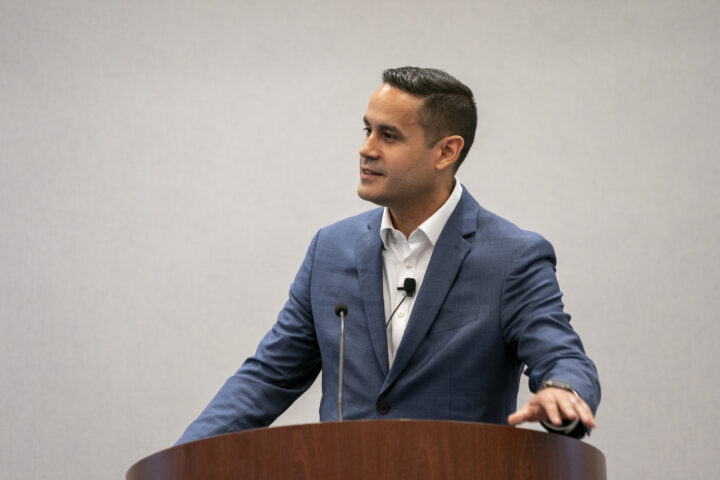
The Gospel writer Luke set out to provide an “orderly account” of the life of Jesus. Yet reading the story backwards yields insights we can appreciate even more today, said Eric Barreto in the second plenary address at 스튜어드십 만화경 on Sept. 24. The annual conference is presented by the 미국 장로교회(미국) 및 미국 복음주의 루터교회.
Barreto is the Frederick and Margaret L. Weyerhaeuser Associate Professor of New Testament at 프린스턴 신학교. He said he proposed this topic as a Lenten adult education series at the church he attends. To his surprise, they took it on, reading Luke’s account of the cross on the first Sunday of Lent and working backwards through the text.
“On Palm Sunday, we were in Mary’s arms,” he said.
From a stewardship standpoint, Barreto encouraged listeners to pay attention in particular to Luke’s crucifixion narrative. Look at what it says about what it means to live within (and resist) the bounds of empire, he urged. Also notice how community is key, not secondary, to the good news of Jesus Christ.
Here are a few highlights:
The meaning of the cross

Eric Barreto speaks at Stewardship Kaleidoscope 2024 in Portland, Oregon
The crosses we see at churches or wear around our necks meant anything but hope in Jesus’ time, Barreto said. A cross was a threat of humiliation and excruciating death at the hands of a violent empire.
“The cross is the strangest of good news: the defeat of death with death, eternal life purchased with the death of God’s son, forgiveness shared in a place utterly devoid of mercy,” Barreto said.
No one story can capture its full meaning. Luke wrote for an audience who’d heard the story before, but something compelled him to bring it to life in a new way.
A tale of trauma and grief
The power of the state to seize and destroy weighs heavily in Luke’s account of the crucifixion, Barreto said.
Two individuals were crucified along with Jesus. One taunted him. The other said Jesus was innocent and the two criminals had been condemned justly.
Jesus told both: “Today you will be with me in paradise” — not just someday, but today.
That was “an audacious promise,” Barreto said.
Others present at the crucifixion agreed Jesus was innocent; he was not the first innocent person to be crushed by an empire and would not be the last. Some were there for the spectacle of a public execution. Some went home beating their breasts in agony.
Barreto then showed photos of migrants at the border, a demonstration following George Floyd’s murder — Floyd had “the weight of empire on his neck” — and more.
“The cross shows us the depth of our own inhumanity,” Barreto said. “We have trusted empires’ violence all too much.”
Rethinking sacrificial giving
Jesus warned of the scribes who walk around in long robes, commanding respect and grabbing the best seats and places of honor. He also said they “devour widows’ houses.”
Then he saw a widow place two coins, all she had to live on, in the treasury along with the gifts of the rich.
“So often we read this as a stewardship text exhorting sacrificial giving,” Barreto said.
On the heels of what Jesus had just said about widows’ houses being devoured, it could be read as the widow’s “house” being devoured by an empire demanding a lot of those who have little and little of those who have a lot.
The one who dared to believe
An angel visited a presumably young, poor, uneducated woman in the middle of nowhere in the empire. Mary was naturally perplexed at being called “favored one.”
“In what way is she favored in this world?” Barreto asked.
Though perplexed, Mary was unafraid even when the angel described what was being asked of her. To dare to believe what the angel was telling her was dangerous, he said. Perhaps asking “how can this be?” was not about conception but about how a world-upending prophet could come from her circumstances.
Mary’s powerful song when she visits her cousin Elizabeth is not a one-off, Barreto said.
Someone, after all, had to teach Jesus how to walk, talk, pray and believe in the God of Israel. It’s not hard to believe his mother might have sung that song to him over and over, Barreto said. You can hear Mary’s voice when Jesus speaks, but the beginning of his ministry is not the beginning of his story.
“This started when one woman believed, when one woman trusted God’s promises and said yes to God,” Barreto said.
Maybe reading Luke’s story backwards can help us trust God as we confront our bounds of empire, too.
“This old, old story is never really done with us,” he said.
낸시 크로우
낸시 크로우는 인디애나주 포트 웨인에 거주하는 작가이자 편집자, 동물 건강 전문가입니다. 루이빌 장로교 신학교를 졸업했습니다. 이 기사에 대한 의견을 Presbyterian Foundation의 커뮤니케이션 및 마케팅 담당 부사장인 Robyn Davis Sekula에게 보내주세요. robyn.sekula@presbyterianfoundation.louderstaging.com.
 Korean
  English
  Spanish