
10/5/2023
청지기 직분에 관한 전례는 우리가 무엇을 공유해야 하는지에 대한 깊은 이해가 필요합니다.
by 조디 마스크 목사
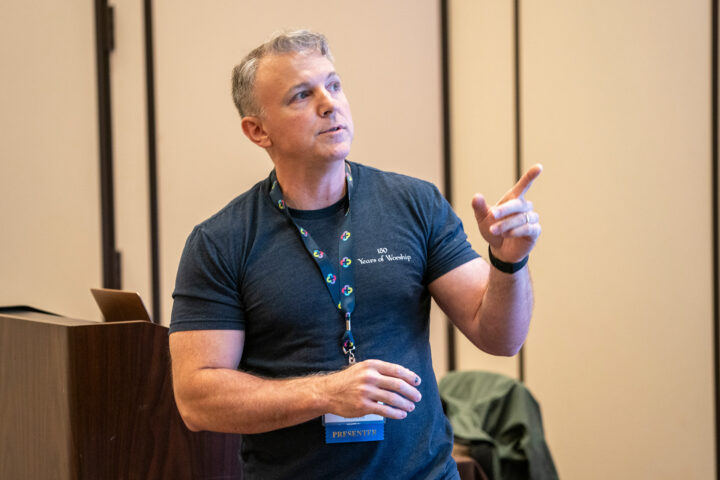
If you are a word nerd like Rev. Kendal Land of First Presbyterian Church in Longview, Texas, then you know that “liturgy” comes from the Greek word leitourgia meaning “the work of the people.”
In his workshop Developing a Liturgy of Abundance at Stewardship Kaleidoscope Conference 2023, he presented ways to incorporate themes of abundance within the church’s liturgical worship. 스튜어드십 만화경 is an annual conference, and was held this year in Minneapolis Sept. 25 to 27. The 장로교 재단 is a sponsor.
Liturgy, according to The Westminster Dictionary of Theological Terms, is “the service of God offered by the people of God in divine worship.” Keeping God at the center of both worship and the liturgy of abundance is important. Land shared a quote from Glen Packiam that solidified this point: “If formation is the goal of worship, then we have missed the point of worship.”
Three terms particularly shaped the workshop. The first was scarcity. Per the book Scarcity: The New Science of Having Less and How it Defines our Lives by Sendhil Mullainathan and Shafir Eldar, scarcity simply means “having less than you feel you need.” Land told a story of his grandparents, whose experience living in the Depression led them to “use Cool Whip containers as Tupperware,” a practice that generated knowing glances and head nods from attendees.
Land contrasted that definition of scarcity with his own definition of abundance: “having enough to meet the needs of the person or community.” And he connected these opposing ideas with that of generosity, which he defined as “the willingness to give of one’s resources to another.” As feelings of scarcity give way to those of abundance, generosity flows. And feelings play a big role in this work: Mullainathan and Eldar caution that scarcity is real in that perception is reality.
Those authors approach scarcity from a scientific point of view which is instructive, but Land also focused on the theology of scarcity and its counterpart, a theology of abundance. He mentioned Walter Brueggemann’s article “The Liturgy of Abundance, The Myth of Scarcity” which first appeared in 기독교 세기. In that article, Brueggemann noted that in Genesis 47, it is the pharaoh of Egypt who first introduces the principle of scarcity into the world economy–and it has plagued communities of faith ever since.
Sometimes, a church community captive to a scarcity mindset could benefit from having someone not connected to the community to provide an outsider’s perspective. Land told the story of a consultant hired to help a surgical center manage its workflow more efficiently. Employees were burning out as they were required to stay longer each day to finish their vital work. The consultant advised that the center should leave one of its operating rooms open to emergencies only. Though counterintuitive, they took the advice. Within a year, employees were able to finish their work on time instead of being extended due to scheduling that insufficiently accounted for the unplanned surgeries they performed.
Another way to upend the scarcity mindset for churches is through ordo, a term most folks only hear in academic discussions of theology. Land cited Martha Moore-Keish of Columbia Seminary, who writes “‘Ordo,’ as it has come to be used, suggests the basic structure of Christian worship that centers on table, font, and pulpit, and the shape of Christian living that flows from these centers. It is a commitment to that which grounds and guides our lives in the world.”
Ordo is more expansive than a simple order of worship. It begins with worship, but follows worshipers outside the sanctuary and ideally shapes their whole life. “The rhythms of our life should reflect what we do on Sunday,” Land explained.
Since the ordo flows from the worship space, growing a sense of abundance among the people of God begins with the elements of worship and how they are arranged. For example, Land suggested closing the service with the offering, which connects what people do in the sanctuary to what they promise to do in the world: offer their material gifts and their gifts of service to a world in need. This suggestion prompted folks in the room to share their congregation’s liturgical practices, such as showing slides of members doing good works in the community while the offering is collected.
Land included a couple of cautions: first, that the liturgy should include feelings of scarcity to the degree that they reflect what the community experiences, just as the psalms often include themes of abundance in concert with themes of scarcity. Second, be sure of your motivation for generosity. Studies show that people who are generous regardless of how much money they have lead happier lives (per the book The Paradox of Generosity: Giving we Receive, Grasping we Lose by Christian Smith and Hilary Davidson). However, if your motivation is to force a happy life by giving more, it will not work.
Land completed the workshop with some sample liturgical texts that focus on generosity as well as hymn suggestions. One of the texts, attributed to St. Ignatius, says “Lord, teach me to be generous, to serve you as you deserve, to give and not to count the cost, to fight and not to heed the wounds, to toil and not to seek for rest, to labor and not to look for any reward, save that of knowing that I do your holy will.”
This prayer reminds us of the God-centered nature of liturgy. As God is abundantly generous, so might we be.
조디 마스크 목사
조디 마스크 목사는 플로리다주 올랜도에 있는 그레이스 커버넌트 장로교회의 임시 담임목사입니다. 올랜도 출신인 그는 장거리 달리기, 자연 속에서 보내는 시간, 배우자 엘렌과 함께하는 취미 생활을 통해 자신의 웰빙을 돌보고 있습니다. 이 이야기에 대한 질문이나 의견이 있으시면 장로교 재단의 커뮤니케이션 및 마케팅 담당 부사장인 로빈 데이비스 세쿨라에게 다음 주소로 보내주세요. robyn.sekula@presbyterianfoundation.louderstaging.com.
 Korean
  English
  Spanish