
10/10/2023
풍요와 은혜로 청지기 직분을 재구성하기
by 낸시 크로우
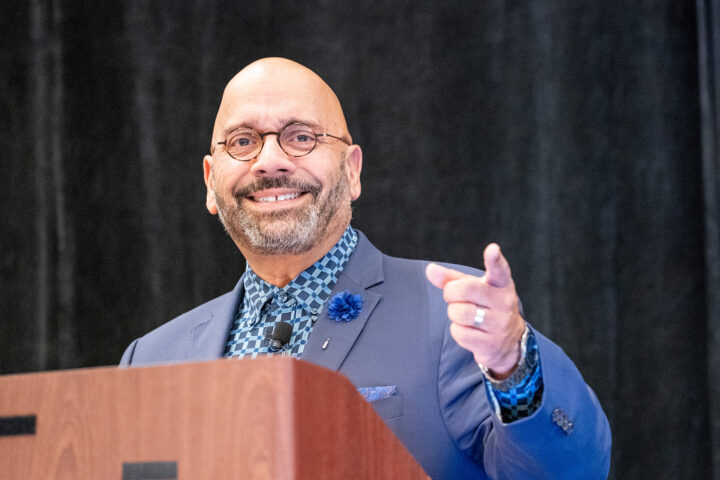
Stewardship has many layers. Rev. Dr. Victor Aloyo, 11th president of 컬럼비아 신학교 in Decatur, Ga., began by acknowledging some visible ones.
Such as: the grief and loss of the pandemic. The joy of “God creating a new thing.” His own story as a child of immigrants from Puerto Rico, as a husband and as a father of two adult daughters. The opportunities for ministry and service in his lifetime.
Amid all of that, and in a time when fear of scarcity abounds, Aloyo called for a reframing of stewardship. His plenary address was part of 스튜어드십 만화경, a conference about generosity and stewardship, Sept. 25-27 in Minneapolis. It is sponsored by the 장로교 재단.
What gets in our way
In finding new pathways to abundance and grace, we confront three challenges, Aloyo said:
- We live as individuals, disconnected from and unaware of — even indifferent to — the needs of others.
- Our fear that there will not be enough creates that reality, usually that there is enough for the other person and not for us.
- We own nothing. Everything is a gift from God.
A biblical framework
Fortunately, there is precedent spanning centuries: a recurring biblical call to care for creation, those who have little and those deemed undeserving.
Some of it flies in the face of what we think we know about the way things work, Aloyo added. “Stewardship ought to be countercultural.”
In Genesis 1:28, God told the first humans to be fruitful, increase in number and subdue and rule over the earth and every living thing. All life is regarded as significant, Aloyo said, adding the word “subdue” did not carry the meaning of domination that it does today.
The relationship between the humans and the rest of creation can be seen not as hierarchical but symbiotic, he said, and never as an excuse for exploitation. “The effects of irresponsible consumption of resources, and effects on those with limited resources, have been documented for centuries.”
Isaiah 55:1-9 exhorts all who are thirsty to come to the waters and for those with no money to “(c)ome, buy wine and milk without money and without cost.”
“What is promised here is outrageous,” Aloyo said. “The economy of the promise here is built not upon the scarcity of exile but upon God’s abundance. … Buy even if one lacks money? How? What seller would allow that?”
The passage continues: “Why spend money on what is not bread, and your labor on what does not satisfy? Listen, listen to me, and eat what is good, and you will delight in the richest of fare.”
This “outrageous abundance” opens the way for hearing a renewed covenant, Aloyo said. “Eating what is good” is conjoined with careful listening.
Divine fairness and sowing with abandon
World history has demonstrated the effects of abusing power, squandering resources and perpetuating injustice. So we might have trouble with stories that seem to endorse injustice and waste.
One is Matthew 20:1-16, the parable of the workers in the vineyard. The first ones hired, who had worked all day in the heat, expected to be paid more than those who had worked only one hour.
Aloyo asked: Is this about generosity, or exploitation? “We could all tell our own version of this parable.”
We’ve been taught fairness matters, but too often our notions of fairness give a false assurance of order, he said. That’s not how grace works: “What happens when divine goodness trumps human fairness?”
We are all much more than how many hours we’ve put in or how we look or behave, Aloyo said. The first hired saw themselves as different from and more deserving than the last hired … but neither group owned the vineyard.
Then in Matthew 13:1-9, Jesus talks about the farmer sowing seed. Some seed fell on the path and got eaten by birds, some fell on rocky ground and couldn’t take root and some fell among thorns and got choked by them. Other seed fell on good soil and produced a yield many times what was sown.
Consider the seeds Jesus is sowing in you, Aloyo urged.
“The sower” — he threw his arms wide — “sows the seeds with such abandon, but with such abundance.”
We all have characteristics of those less-than-ideal growing environments, Aloyo said. We strive for efficiency and a return on our investment. The way of the sower, who isn’t worried about the harvest or how much it will yield, is not our way.
“But there is more than enough. You want to know why I understand that? I am looking at it right now,” he told the audience. “The seeds of your story, your talent, your gifts.
“When we sow in abundance, we will experience God’s blessings tenfold,” he said. “And the restoration of God’s creation, which includes you and me, will continue to take place.”
낸시 크로우
낸시 크로우는 인디애나주 포트 웨인에 거주하는 작가이자 편집자, 동물 건강 전문가입니다. 루이빌 장로교 신학교를 졸업했습니다. 이 기사에 대한 의견을 Presbyterian Foundation의 커뮤니케이션 및 마케팅 담당 부사장인 Robyn Davis Sekula에게 보내주세요. robyn.sekula@presbyterianfoundation.louderstaging.com.
 Korean
  English
  Spanish